Patient-derived organoids are three-dimensional cultures grown from patient tissue; patient-derived xenografts (PDX) are patient tumors grown in animal hosts, usually mice. Both can support oncology research, but they retain different aspects of tumor biology. Mordor Intelligence estimates the broader organoids market at $1.20 billion in 2025 and $1.42 billion in 2026, with a projection of $3.29 billion by 2031, equivalent to an 18.31% CAGR from 2026 to 2031. Those figures describe commercial expectations across organoid applications. They do not establish whether organoids replace particular animal studies or improve a specific development decision. That decision starts with what the experiment needs to measure.
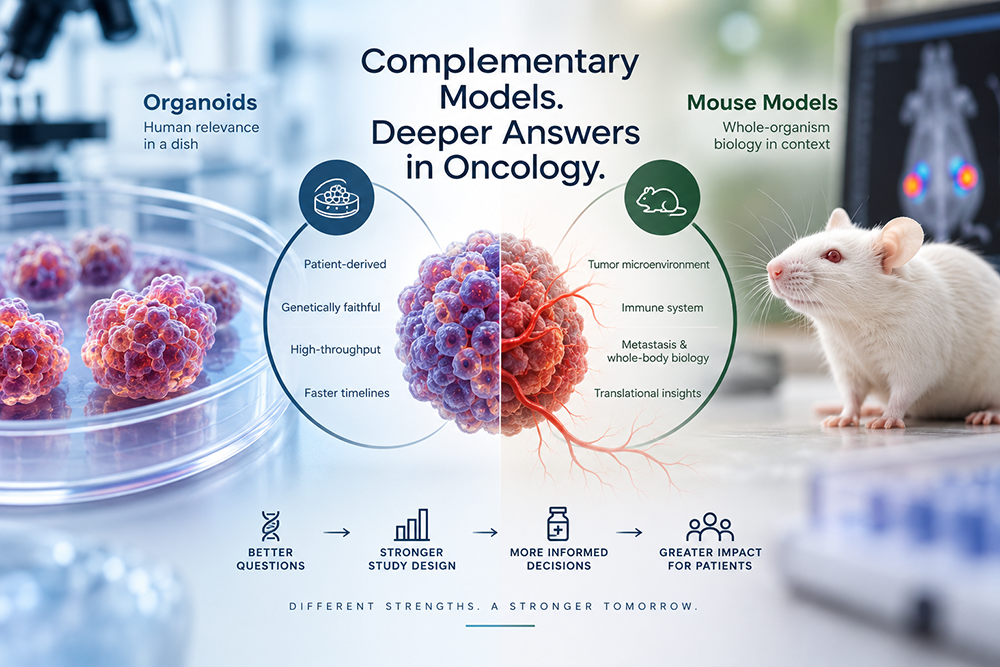
Organoids and mouse models answer overlapping but different questions. Organoids can support parallel testing of tumor-cell responses, while mouse studies can examine drug exposure and efficacy in an intact organism. Neither reproduces every feature of the patient: conventional tumor organoids usually lack a sustained native immune and stromal compartment, and standard PDX models use immunodeficient hosts. Immune co-cultures, humanized mice, and other specialized systems require their own validation.
| Question | Patient-derived organoid | PDX / mouse model |
|---|---|---|
| Time to first result | Days to weeks for assays; culture establishment adds time | New PDX establishment and expansion often take months |
| Throughput | Parallel drug and combination testing; assay-dependent | Often lower; constrained by study design, animal numbers, and cost |
| Systemic pharmacology and metastasis | Standard cultures lack whole-organism ADME; invasion can be studied | In vivo exposure and efficacy; metastasis requires an appropriate model |
| Tumor-intrinsic drug response | 3D tumor-cell responses; immune studies need suitable co-culture | In vivo tumor responses; standard PDX hosts are immunodeficient |
| Cost per data point | Often lower after establishment; depends on assay scale | Often higher; depends on model and study design |
| Best use in a program | Candidate triage, resistance studies, combination screening | In vivo efficacy and exposure-response studies |
A meta-analysis first released in 2025 and published in Cancer Treatment Reviews in 2026 evaluated 411 matched patient-model pairs (267 PDX and 144 organoid). It reported roughly 70% concordance between model and patient treatment response, with no statistically significant difference between model types. This supports the relevance of both approaches, but absence of a significant difference does not establish equivalence. The studies also differed in tumor types, treatments, and response definitions. Organoid screening can help prioritize candidates for mouse studies when the assay captures the mechanism of interest; this analysis does not demonstrate that every program benefits from running both.
The prospective OPTIC study, published in Clinical Cancer Research in 2025, provides treatment-specific evidence in metastatic colorectal cancer. Its interim analysis screened 42 patient-derived organoid cultures, focusing on oxaliplatin-based doublet chemotherapy. The 5-fluorouracil and oxaliplatin screens showed an area under the ROC curve (AUC) of 0.78 to 0.88, and organoid responses were associated with progression-free and overall survival. These findings support further validation in that setting. They do not show that selecting treatment with an organoid assay improves survival or that the same performance extends to other cancers and therapies.
The FDA published a roadmap in April 2025 to reduce animal testing in nonclinical safety assessment, initially emphasizing monoclonal antibodies and encouraging New Approach Methodologies (NAMs), including organoids, organ-on-chip systems, and computational models. In April 2026, the agency reported that it had met its first-year goals. The roadmap describes an ambition for animal testing to become the exception rather than the default within three to five years, approximately 2028 to 2030. This is a phased policy direction, not a universal deadline for eliminating animal studies.
The distinction matters for oncology programs. The roadmap focuses on nonclinical safety and toxicology; it does not require the removal of mouse efficacy models from drug discovery. An organoid efficacy result also does not automatically replace a toxicology study. The FDA evaluates whether a NAM is fit for its proposed context of use, with appropriate validation and supporting evidence. Its March 2026 general NAM guidance remains draft guidance. Teams planning to use these data in a submission should define the regulatory question and discuss the evidence package with the relevant FDA review division.
A workable sequence starts by allocating fresh tumor tissue to organoid generation and, where justified, a PDX study. Once sufficient viable material is available, organoid drug-sensitivity assays can return results in days to weeks. Establishing and expanding a new organoid culture adds time and is not always successful. PDX establishment and expansion commonly take months, with substantial variation by tumor type and model. Early organoid data can help prioritize compounds or combinations for in vivo testing and identify resistance hypotheses worth examining. Mouse studies then address exposure, tolerability, or efficacy questions that the culture system cannot resolve on its own.
DRL's workflow connects fresh tumor procurement, primary organoid and cell models, and Bio-Verify assays to support IND-enabling research alongside a program's in vivo work. The study plan needs to define assay validation, traceability, and any GLP requirements for the intended use of the data; an integrated workflow alone does not make a dataset IND-ready.
Organoids can reduce reliance on animal experiments for some questions and complement PDX or other mouse models for others. They are useful for tumor-intrinsic drug screening, while suitable in vivo models can address exposure and whole-organism effects. The appropriate combination depends on the mechanism and study endpoint.
The meta-analysis of 411 matched patient-model pairs reported roughly 70% concordance with patient treatment response and no statistically significant difference between PDX and organoid models. That finding does not prove equal predictive performance across cancers, therapies, or assay designs.
The FDA roadmap focuses on reducing animal testing in nonclinical safety and toxicology, initially emphasizing monoclonal antibodies. It does not require oncology programs to remove mouse efficacy models. Whether organoid or other NAM data can support a submission depends on the specific use, validation, and regulatory assessment.
One approach is to derive organoids and a PDX from matched tissue, using organoid drug-sensitivity data to prioritize candidates for in vivo testing. Assay time should be distinguished from the time needed to establish and expand each model. Tissue availability, culture success, and PDX growth determine whether that sequence fits the program.
If you are evaluating where organoid screening could sit alongside your existing in vivo pipeline, we can discuss the biological question, available tissue, and timeline.
Start a conversation with DRL's team